How Much Money Is Enough to Retire in India in 2026?
See how inflation, healthcare costs and your withdrawal rate each change your retirement number, with a Bengaluru family example

Get data-backed market insights
Well-researched articles on markets, equities, mutual funds and investing, delivered to your inbox.
Ask ten people how much money is enough to retire in India and you will get ten different answers. One website says ₹2 crore, a news story says ₹40 crore, and your uncle says a paid-off flat and a few FDs are plenty. 🤔 This article answers one question in plain numbers. How much money will your family need when you retire, and what decides that number?
The confusion is not because people are bad at maths. Most numbers online rest on hidden guesses about how fast prices rise, how long you live and how much you take out each year. Change any one of them and the answer moves by crores.
Below, we work through one Bengaluru family step by step. Then we turn each dial, inflation, healthcare and withdrawal rate, one at a time to show how much it matters.
How much money is enough to retire in India?
Enough money to retire in India is roughly 27 to 30 times your first year of retirement spending, counted in rupees at the date you retire. That multiple assumes the money must last from age 60 to 90, earns 8% a year, and faces 6% general inflation and 10% healthcare inflation.
The method behind that answer has three simple steps. First, write down what your retired life would cost each month in today's prices, leaving out school fees, the home loan EMI and other costs that end before you retire. Second, grow that amount by inflation until the year you retire. Third, divide one year of that future spending by a withdrawal rate.
A withdrawal rate is the share of your corpus you take out in the first year of retirement, after which the yearly amount rises with inflation. Your corpus is the total pot you build for retirement, including EPF, NPS, PPF and mutual funds.
If you will get a pension or rent, subtract that income from your yearly spending first, because the corpus only has to cover the gap.
Dividing by a 3.5% withdrawal rate is the same as multiplying by about 28.6, which is why the answer is often written as a multiple. The 25 times rule used in the FIRE method for early retirement is the same idea with a 4% withdrawal rate. As you will see below, 4% can be too high once Indian healthcare costs are counted.
Why do retirement numbers online range from ₹2 crore to ₹40 crore?
Retirement corpus numbers online range from under ₹2 crore to ₹40 crore mainly because some are in today's rupees and some are in future rupees. The same plan, priced 20 years ahead, looks about three times bigger at 6% inflation. Different guesses about spending, inflation and lifespan explain the rest.
Take a widely shared Business Today story from May 2026. It said a metro family spending ₹1 to 2 lakh a month may need around ₹40 crore by age 60. A number like that can make retirement feel out of reach for salaried families. 😢
What the headline misses is the date printed on that rupee. The story used about 9% yearly inflation for 20 years, which turns ₹2 lakh of monthly spending into about ₹11.2 lakh by 60. At that same 9%, ₹40 crore is about ₹7.1 crore in today's prices. That is still large, but it belongs to a family spending ₹2 lakh a month today.
The opposite mistake happens too. Some pages divide today's spending by a withdrawal rate and never grow it up to the retirement date. The result looks comfortingly small, but it is far too low for anyone still 15 or 20 years away.
Think of a cutting chai that costs ₹15 today. At 6% inflation, the same cup costs about ₹48 in 20 years, because only the rupee has shrunk. So before you believe any retirement number, ask whether it is in today's money or money at retirement, and what spending, inflation and lifespan it assumes.
How much money do I need to retire in Bangalore?
A Bengaluru couple who would spend ₹80,000 a month in today's prices needs about ₹9.4 crore at age 60 in this illustration. In today's money, that equals about ₹2.9 crore. The figure assumes they retire in 20 years, own their home, earn 8% a year and need the money to last until 90.
Meet Rohan and Priya Rao, a made-up couple used only as an example. Both are 40 and live in Bengaluru, with two school-going children and a home loan that ends before they turn 60. Their school fees, EMI and children's costs will be gone by retirement.
The first step is their retired-life budget in today's prices. They estimate ₹70,000 a month for food, bills, house help and travel, plus ₹10,000 for health insurance and medical bills, so ₹80,000 in total.
The second step is inflation, the yearly rise in prices. India's Cost Inflation Index, which the Income Tax Department uses for capital gains, went from 100 in 2001-02 to 384 in 2026-27, or about 5.5% a year. Retail inflation was 6.09% in October 2026, as per MoSPI's latest CPI release. So we use 6% a year for regular living costs.
Healthcare gets its own, higher rate. Aon's 2027 Global Medical Trend Rates report, released in October 2026, projects that medical costs in India will rise 10.1% in 2027, against general inflation of 4%. We use 10% for healthcare. At these rates, ₹70,000 of living costs grows to about ₹2.24 lakh a month by 60, and ₹10,000 of healthcare grows to about ₹67,000.
The third step is the withdrawal rate. The Raos' first year of retirement will cost about ₹35 lakh. If their money earns 8% a year and must last until 90, they can start by taking out about 3.7% of the corpus. Divide ₹35 lakh by 3.7% and you get about ₹9.4 crore.
The 8% return is an assumption for a mix of equity and debt funds after retirement, not a projection, and real returns go up and down every year. If the Raos rented instead of owning their home, the number would be much bigger.
How much do inflation, healthcare and withdrawal rate change your number?
Inflation, healthcare costs and the withdrawal rate can each move a retirement number by crores. For the Bengaluru couple in this illustration, one extra point of inflation adds about ₹2.3 crore at 60. Healthcare rising at 12% instead of 6% adds about ₹5.3 crore, and a 3% withdrawal rate instead of 4% adds about ₹2.9 crore.
The table moves one dial at a time and keeps everything else the same, with all figures in rupees at age 60.
| Dial | Setting | Corpus needed at 60 |
|---|---|---|
| Starting point | 6% inflation, 10% healthcare, 3.7% withdrawal | ₹9.4 crore |
| General inflation | 5% a year | ₹7.8 crore |
| General inflation | 7% a year | ₹11.8 crore |
| Healthcare inflation | 6%, same as everything else | ₹7.1 crore |
| Healthcare inflation | 12% a year | ₹12.4 crore |
| Withdrawal rate | 4%, money runs out around 87 | ₹8.8 crore |
| Withdrawal rate | 3%, money lasts to about 97 | ₹11.7 crore |
Source: Illustration using this article's assumptions.
Inflation matters so much because it works for half a century. The Raos' spending grows for 20 years before they retire and 30 more after. With the same 8% return, one extra point of inflation turns ₹9.4 crore into ₹11.8 crore.
Healthcare is the dial most people forget. Indian families paid 42.7% of the country's total health spending from their own pockets in 2023-24, as per the Health Ministry's National Health Accounts released in November 2026. In the Raos' plan, healthcare is one-eighth of today's budget. Because it rises faster, it becomes about 23% of spending at 60 and close to half by their late 80s. 😢
That is why healthcare needs about a third of their whole corpus. A good health insurance policy protects against big hospital bills, but premiums rise with age, so they belong inside this number too.
The withdrawal rate decides how long the money lasts. The popular 4% rule comes from US research. Morningstar's State of Retirement Income report for 2026 puts the safe starting rate for US retirees at 3.9% for a 30-year retirement, using US markets and US prices. In the Raos' case, healthcare rising at 10% makes a 4% start run out around age 87, while 3.5% lasts until about 91.
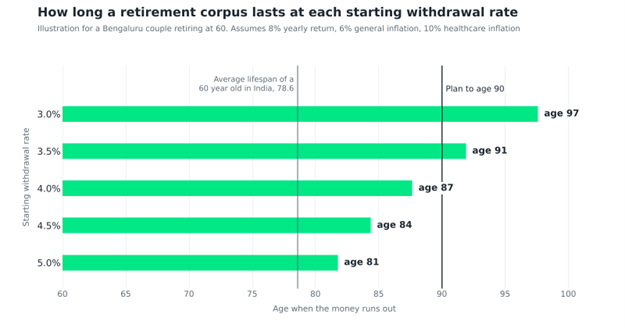
Source: Vinca Wealth illustration. Average lifespan from the SRS Abridged Life Tables 2020 to 2024, published May 2026.
Why plan until 90?
The SRS Abridged Life Tables for 2020 to 2024 show that a person who reaches 60 lives another 18.6 years on average, 17.5 for men and 19.8 for women. An average is only the middle, so many people live well past 79. In a couple, the chance that one partner reaches the late 80s is higher still.
These three dials explain why a number copied from the internet rarely fits your family. The more useful question is how close your own savings already are to the amount you will need. Our Financial Freedom Score shows you that in about two minutes.
Is ₹2 crore or ₹3 crore enough to retire in India?
₹2 crore or ₹3 crore can be enough to retire in India if retirement is near and monthly spending is modest. At a 3.5% starting withdrawal rate, ₹2 crore pays about ₹58,000 a month and ₹3 crore about ₹87,500 a month in the first year. The further away retirement is, the less that money buys.
What matters is the year you start spending it. Picture three people who each reach ₹3 crore on their retirement day. A person retiring this year gets ₹87,500 a month, worth exactly that in today's prices. Someone retiring in 10 years gets the same ₹87,500, but at 6% inflation it buys what about ₹49,000 buys today.
A 40-year-old retiring in 20 years is in the toughest spot, because their ₹87,500 a month buys only what about ₹27,000 buys today. ₹2 crore works the same way, giving about ₹58,000, ₹33,000 and ₹18,000 a month in today's money for the three people.
So for most people between 30 and 50, ₹2 crore or ₹3 crore is a milestone, not the final target. For a city family like the Raos, the matching number at 60 is closer to ₹9 to ₹10 crore. A smaller city, a paid-off home or a pension can bring it down a lot. 🙂
What should you do now to reach your retirement number?
Reaching a retirement number starts with three facts you can write down today. These are your retired-life spending in today's prices, the years left until you retire, and your savings so far. After that comes steady investing, raising your monthly amount as income grows, and a check once a year.
- In your 30s. Time is your biggest helper, because your first ₹1 crore takes the longest to build. Start a monthly SIP and raise it when your salary rises.
- In your 40s, like the Raos. Write your retired-life budget in today's prices, leaving out school fees and EMIs. Then turn it into a number at 60 using 6% to 7% inflation.
- Within 10 years of retirement. Plan how you will draw money, for example a bucket strategy with a systematic withdrawal plan (SWP), so a bad market year does not force you to sell.
- Everyone. Keep healthcare as its own line, buy health cover early while premiums are lower, and subtract pensions and rent before you size the corpus.
- Avoid this. Never copy a number from social media without checking which year's rupees it is in.
Nobody knows what inflation or market returns will be over the next 50 years, and that includes us. Every figure above is an illustration built on stated assumptions, not a projection. A plan you check every year or two can be corrected early.
This checklist covers most families, but your own number depends on your age, your city, your spending and the funds you already hold. If you would like someone to look at how your mutual funds line up with your retirement number, you can book a consultation with the Vinca Wealth team.
Frequently Asked Questions
What is a retirement corpus?
A retirement corpus is the total money you build for retired life, such as EPF, NPS, PPF and mutual funds. Once your salary stops, you draw from it every year.
Do EPF and NPS count towards my retirement number?
Yes. EPF, NPS, PPF and mutual funds all add up to one corpus. Estimate what each will be worth at retirement, add them together and compare the total with your number to see the gap.
Is the 4% rule safe for retirees in India?
Not always. The 4% rule comes from US research. In our illustration with healthcare costs rising 10% a year, a 4% start ran out around age 87, while 3.5% lasted past 90.
Does retiring at 55 instead of 60 change the number?
Yes, a lot. In our illustration, the couple would need about ₹7.7 crore at 55, which is ₹3.2 crore in today's money. That is more than retiring at 60, with five fewer years to save.
Is Vinca Wealth registered?
Yes. Vinca Wealth is an AMFI registered mutual fund distributor (ARN-293401), based in Bengaluru, Karnataka. Our company CIN is U65999KA2022PTC169569, and our Insurance POSP Code is 1726204591.
Do I have to pay Vinca Wealth any fee?
No. We don’t charge you a fee for planning or investing. As a mutual fund distributor, we receive a commission from the fund houses whose schemes you invest in, and we disclose this upfront. You invest directly from your bank account to the fund house; your money never passes through Vinca Wealth.
How can I find out if I’m on track for retirement?
Start with our free Financial Freedom Calculator on vincawealth.com. In about 2 minutes it estimates your retirement corpus, your gap and your projected retirement date. You can then book a one-on-one session with our team to build a goal-based plan.
Can I meet the Vinca Wealth team?
Yes. We meet clients one-on-one at our office in Bengaluru or at a place of your choice in Bengaluru. If you live in another city or outside India, we connect over a video call.
About the Author
Prudhvi Raj
Vinca VerifiedSenior Financial Analyst
15+ Years of Experience In the Wealth Management Industry.