NRI Digital KYC, Invest in India Remotely Without Visiting

Get data-backed market insights
Well-researched articles on markets, equities, mutual funds and investing, delivered to your inbox.
You are an NRI.
Every month, a slice of your salary takes a flight home. It pays an EMI, a parent’s medicines, or a cousin’s wedding outfit that somehow costs more than your first car. The rest sits in an NRE fixed deposit, quietly doing its job.
Meanwhile, in the family WhatsApp group, your cousin in Pune posts a screenshot of SIP done & Everyone claps. You send a thumbs up from another time zone and wonder why you never did the same. 🤔
The reason was simple, and a little silly is that to open an investment account, India needs to verify who you are. For years, that verification often meant being in India while it happened.
But on 4 November 2026, SEBI changed that. This article explains what changed, how the new process works, and why it may be worth your attention even if you have never bought a single mutual fund.
What has SEBI changed for NRIs?
From 3 December 2026, an NRI, OCI cardholder or foreign national living in a country that meets global anti-money-laundering standards can complete KYC digitally from abroad. A live video call replaces the trip to India. The rule comes from a SEBI circular dated 4 November 2026. An OCI, in case the term is new, is an Overseas Citizen of India, someone of Indian origin who holds a foreign passport.
KYC, short for Know Your Customer, is the identity check every investor goes through before opening an account. The countries that qualify are those that FATF treats as compliant. FATF, the Financial Action Task Force, is the global watchdog against money laundering. As the Times of India reported, most countries where Indians live, including the US, UK, Canada, Australia, the UAE and Singapore, fall in the compliant group. If you live in a country that FATF treats as non-compliant, the older process continues for you.
One honest note. SEBI has permitted this, but the circular does not force any firm to offer it. Each broker, fund house and distributor builds its own process, so your real start date is the day your chosen firm is ready. KYC completed before 3 December also stays under the old rules.
How did NRIs do KYC before, and why was it such a hassle?
Before this change, easy digital KYC, where you fill in forms, upload documents and get verified online, worked only if you were physically in India at that moment. Firms had to check your location while you did it. Outside India, you were left with the slower paper route.
Meet Rohit, 38. He works for a shipping company in Dubai, and his parents live in Pune. He has ₹40 lakh sitting in NRE fixed deposits, and the words mutual fund remind him of a lecture he once slept through. In March, Rohit decides he wants to start investing back home. But the rule says come to India. So the plan waits for the December holiday.
He lands, and his two weeks are already full the family function, the uncle who must be visited, the other uncle who must also be visited, the passport renewal, the shopping. Account opening gets squeezed between a wedding and an airport run. Many people never get to it at all, and the FD carries on as before.
SEBI had already eased one piece. In December 2025, it relaxed the in-India location check for existing NRI clients redoing their KYC. But a brand-new NRI investor still had to be in India. The November circular removes that wall for new onboarding too.
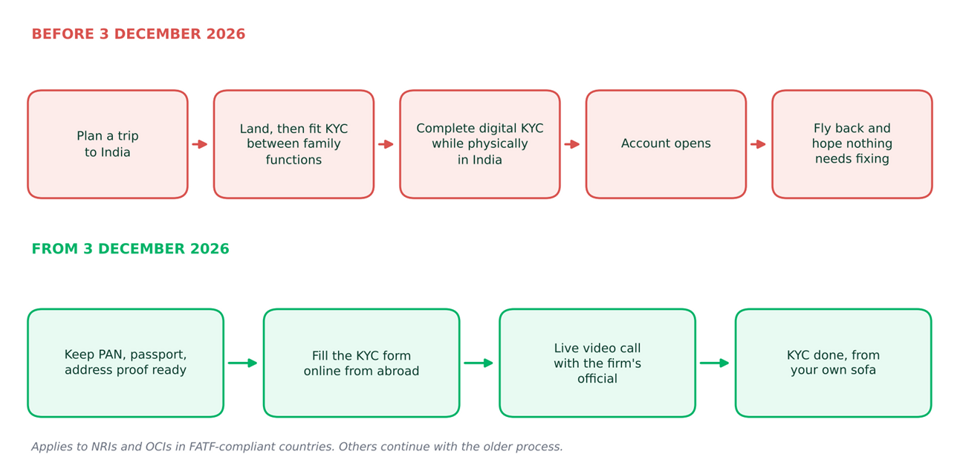
How does the new video KYC work, step by step?
You submit your details online, then a live video call lets the firm confirm it is really you. In practice, it takes five steps.
- Pick a SEBI-registered firm = This can be a broker, a fund house or a mutual fund distributor (Like Vinca wealth) that has switched on NRI video KYC for your country.
- Keep your documents ready = You will need your PAN, passport, address proof and, if you hold one, your OCI card. All documents must be in English.
- Fill in the KYC form online = Your signature can be digital too, If you upload a digital one, you must also sign on paper during the video call so the two can be compared.
- Join the video call = An authorised official of the firm must be present on the call, and the whole session is audited.
- Get verified and fund your account = Once your KYC record is uploaded to the KYC registry, you can invest from your NRE or NRO account.
SEBI has made the video call strict on purpose. It uses live GPS coordinates, timestamps and anti-spoofing checks, and the session is encrypted, as the Times of India reported, so it cannot be pre-recorded or tampered with. Your internet connection must also show an IP address from India or a FATF-compliant country that matches the country on your form, as Flattrade explains. So no, you cannot send a cheerful video of yourself from 2019 and keep your VPN off during the call.
The second big change is that your KYC becomes portable. Each detail on your record, such as your address or phone number, will be tagged validated or not, depending on whether it was checked against an official database. A firm can then rely on KYC already done by another SEBI-registered firm, or by entities regulated by RBI, IRDAI, PFRDA or IFSCA. So if you have already done KYC with one broker, you won’t necessarily have to repeat the whole exercise with another.
How many Indians live abroad, and where?
As per MEA data for January 2026, there are 3.73 crore overseas Indians. Of these, 1.78 crore are NRIs, who still hold an Indian passport, and 1.95 crore are people of Indian origin, including OCI cardholders. So nearly half of all overseas Indians are NRIs. The new rule covers NRIs, OCIs and even foreign nationals, so its reach is wide.
The Gulf is the biggest cluster, with about 99.7 lakh Indians across six countries and 43.44 lakh in the UAE alone. The US is the largest single country at 60.79 lakh, followed by Canada at 32.48 lakh. These figures count NRIs and people of Indian origin together.
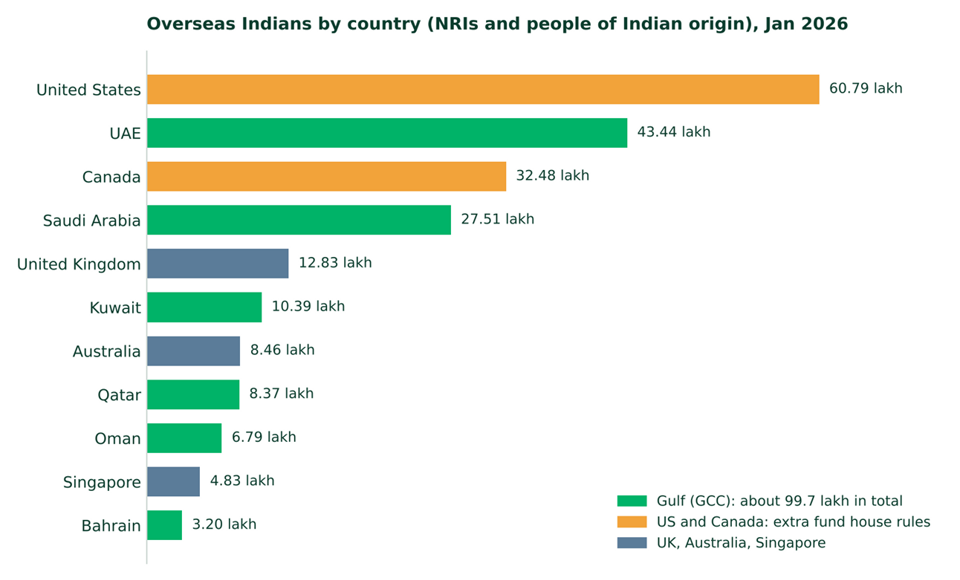
Source: MEA data (January 2026) as reported by Cafemutual. Figures include NRIs and persons of Indian origin.
They also send a lot of money home. India received $150.7 billion in remittances in 2025, the most of any country, according to the World Bank. That money pays rent, school fees and hospital bills, It keeps families comfortable today. The better question is what is building your tomorrow.
Is NRI money invested in India, or mostly parked in deposits?
A large share sits in bank deposits. RBI data show NRIs held about $165.65 billion in deposits with Indian banks at the end of March 2026, across NRE, NRO and FCNR(B) accounts, as Cafemutual reported. At about ₹94 to a dollar, that is roughly ₹15.5 lakh crore.
Now compare that with mutual funds, NRIs held 3.9% of the industry’s assets in March 2026, according to the AMFI-Crisil Factbook 2026. On total assets of ₹73.73 lakh crore, that works out to around ₹2.9 lakh crore. So NRI money in bank deposits is about five times NRI money in mutual funds. Both rupee figures are our own conversions, so read them as approximate. They also leave out direct shares and property, which NRIs hold too, so this compares two specific pots, not the whole picture.
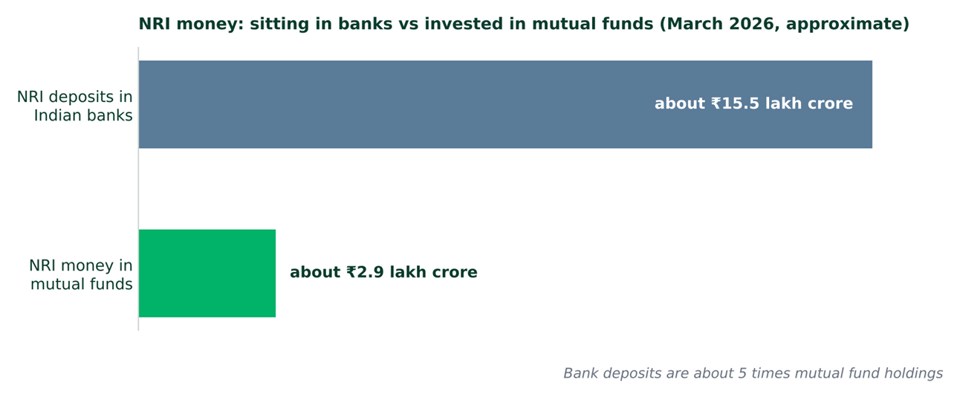
Source: RBI deposit data via Cafemutual; AMFI-Crisil Factbook 2026. Rupee conversion at about ₹94 per dollar is our estimate.
The NRI share has crept up only from 3.1% in March 2021 to 3.9% in March 2026, while the industry’s total assets went from ₹31.43 lakh crore to ₹73.73 lakh crore. Back home, investors set up a record ₹32,490 crore of SIPs in September 2026 alone. A SIP, or systematic investment plan, simply moves a fixed amount into a fund every month, like an EMI that works for you instead of against you.
No one publishes a headcount of NRIs who wanted to invest but couldn’t and KYC was not the only hurdle. Awareness, tax worries and fund house rules played a part too. But it was the first wall, and it is the one SEBI has just taken down.
There is also a quiet cost to leaving everything in deposits. If prices rise faster than your deposit rate, your balance grows but your buying power shrinks. At 7% inflation, which we use as a planning assumption, what costs ₹1 lakh today costs about ₹1.97 lakh in 10 years. Deposits are safe and useful, and NRE interest is tax-free in India. The point is not to leave them. It is to ask whether every rupee needs to stay there.
Why should an NRI invest in India?
Because most NRIs will spend rupees one day, on parents, a home or a return to India, and because India is one of the world’s faster-growing large economies. Investing in India does not mean walking away from your life abroad. It means building something back home as well.
Because your goals are in India
Make a list. Parents healthcare or flat in Bangalore. Maybe the plan to move back once the kids finish school. These are rupee goals, and rupee goals get expensive. Aon expects medical costs in India to rise 11.5% in 2026 and 10.1% in 2027. If you will spend rupees, it helps to save in rupees. That way, the rupee’s ups and downs matter less, because you never have to convert back.
And there is the emotional side. You left India, but India never quite left you. Owning a slice of its growth keeps that connection alive in a very practical way.
Because the growth is real, but so are the bumps
The IMF projects India to grow 6.5% in both FY26 and FY27, against 3.1% for the world. Over 20 years to February 2026, the Nifty 50 TRI returned about 12.44% a year in rupees. TRI, or total return index, counts dividends along with price moves. And over rolling seven-year and ten-year periods since 1999, it has never ended in a loss, according to FundsIndia research.
But the road is bumpy, The same index returned about −1.96% over the latest one year, as per NSE data, and our balanced advantage fund analysis showed the Nifty 500 TRI losing 1.72% a year over two years to 19 October 2026. Markets don’t send a thank-you note for your patience, at least not on a schedule. That is why we talk about seven to ten years, not seven to ten months.
The honest bit about the rupee
You earn in dollars, pounds or dirhams, so the rupee matters to you. It closed around ₹93.7 to a dollar on 11 November and was down about 4.3% in 2026 as of early November. Over the past 5 to 20 years, it has slipped roughly 3.4% to 4.3% a year, according to figures cited by NRI platform Belong.
Here is what that means. If a fund earns 12% in rupees and the rupee loses 3.5% a year, you end up with roughly 8% in dollar terms. That is still a decent number, but it is not 12%. So treat Indian investments as money for rupee goals, and don’t expect every rupee of return to land intact in your dollar account.
What should NRIs check before they invest?
Check four things: where you live, which account you will invest from, how your gains are taxed, and how long you can stay invested.
- Your country. NRIs in the Gulf, UK, Singapore and Australia generally face fewer hurdles. The US and Canada are different. Because of US tax-reporting rules (FATCA), several Indian fund houses restrict investments from residents of these countries, and those that accept them may ask for paper declarations. Lists of accepting fund houses differ from source to source and change over time, so confirm before you apply. If you are a US tax resident, Indian mutual funds are also generally treated as PFICs under US tax law, which brings extra reporting. Speak to a cross-border tax professional.
- NRE or NRO account. An NRE account holds money you earn abroad. It is fully repatriable, and its interest is tax-free in India. An NRO account holds income earned in India, such as rent or a pension, and repatriation from it is capped at $1 million per financial year.
- Tax. For equity funds, gains are taxed at 20% if you sell within 12 months, and at 12.5% on gains above ₹1.25 lakh a year after that. Tax is deducted at source when you sell. Debt fund gains are taxed at your slab rate. Your country of residence may tax the gains too, and a tax treaty may give you credit, so a tax advisor is worth a conversation.
- Time horizon. Equity funds can fall as well as rise. Money you need within the next few years belongs in steadier options. Money you won’t touch for seven years or more can go into equity.
How should an NRI start?
Keep it simple. Four steps are enough.
- List your rupee goals. Write down what you will spend in India and roughly when.
- Keep an emergency fund where you live, in your local currency, before investing anything.
- Complete KYC and open an NRE account if you don’t have one, once your chosen firm is ready for video KYC.
- Start a SIP and review it once a year. Start small if you like. Stopping and restarting costs you more than starting small.
KYC was the lock on the door, and SEBI has handed you the key. But which fund house takes your country, which account to use, how much to invest, and how to handle tax at both ends are still questions worth a proper conversation. If you live outside India, we connect over a video call. Bring your questions, and your NRE statement if you like. We’ll bring the chai, virtually.
Disclaimer: This article is for general information and education only and is not investment, tax or legal advice. Tax and FEMA rules for NRIs depend on your country of residence and personal situation. Mutual fund investments are subject to market risks, read all scheme related documents carefully.
Frequently Asked Questions
Can NRIs complete KYC without visiting India now?
Yes, from 3 December 2026, if you live in a FATF-compliant country and your chosen firm has launched the process. NRIs in non-compliant countries continue with the older process.
Which documents do NRIs need for digital KYC?
Your PAN, passport, address proof and, if you hold one, an OCI card. All documents must be in English.
Do NRIs need an NRE or NRO account to invest?
Yes, Fund houses accept payment from NRE or NRO accounts. NRE money is fully repatriable, while NRO repatriation is capped at $1 million a year.
Is Vinca Wealth registered?
Yes. Vinca Wealth is an AMFI registered mutual fund distributor (ARN-293401), based in Bengaluru, Karnataka. Our company CIN is U65999KA2022PTC169569, and our Insurance POSP Code is 1726204591.
Do I have to pay Vinca Wealth any fee?
No. We don’t charge you a fee for planning or investing. As a mutual fund distributor, we receive a commission from the fund houses whose schemes you invest in, and we disclose this upfront. You invest directly from your bank account to the fund house; your money never passes through Vinca Wealth.
How can I find out if I’m on track for retirement?
Start with our free Financial Freedom Calculator on vincawealth.com. In about 2 minutes it estimates your retirement corpus, your gap and your projected retirement date. You can then book a one-on-one session with our team to build a goal-based plan.
Can I meet the Vinca Wealth team?
Yes. We meet clients one-on-one at our office in Bengaluru or at a place of your choice in Bengaluru. If you live in another city or outside India, we connect over a video call.
About the Author
Prudhvi Raj
Senior Financial Analyst
15+ Years of Experience In the Wealth Management Industry.