How a Balanced Advantage Fund Works, and Did It Buy the Dip?
Data on 34 funds from the 2024 to 2026 fall shows what these funds do inside your portfolio


Get data-backed market insights
Well-researched articles on markets, equities, mutual funds and investing, delivered to your inbox.
Imagine a fund that sells some shares when the market gets expensive and buys more when it gets cheap, without you making a single call. That is the idea behind a balanced advantage fund. Indian investors hold about ₹3.16 lakh crore in this category across 57.7 lakh folios, as per AMFI data for September 2026. A folio is simply your account number with a fund house.
The last two years put this idea to a real test. Markets hit record highs in late 2024 and then fell sharply into early 2026. The Nifty 500 TRI lost more than 20% from peak to bottom before it recovered part of the fall, as The Economic Times reported. TRI, or total return index, counts dividends along with price moves. A fall like that tests even the calmest investor. 😢
So did these funds really buy the dip, and did it help? Here is what the numbers say, and what this kind of fund does inside your portfolio.
How does a balanced advantage fund work?
A balanced advantage fund is a hybrid mutual fund that moves money between equity and debt based on a set model. When shares look expensive, it cuts the part exposed to the market. When shares look cheap, it raises that part. You do not have to sell or buy anything yourself.
SEBI calls this category Dynamic Asset Allocation or Balanced Advantage. Its circular of 26 February 2026 only says that the equity and debt mix is managed dynamically. An aggressive hybrid fund must keep 65% to 80% in equity, as Upstox summarises, but this category has no fixed band.
To understand these funds, you need two numbers. Gross equity is all the shares the fund holds, and net equity is the part that actually moves with the market. The gap between them is the hedged part. Here the fund buys shares and also sells a matching futures contract, which is a deal to sell those shares later at a fixed price. Gains on one side cancel losses on the other, so this part earns a small, debt-like return.
Why hold shares and then cancel out their moves? Most of these funds keep gross equity at 65% or more so that they are taxed as equity funds. They then use hedging to bring net equity down when markets look costly, as Business Standard has reported. So always check net equity in the monthly factsheet.
Did balanced advantage funds really buy the dip this time?
Mostly, yes. Across 34 balanced advantage and dynamic asset allocation funds with at least two years of history, average net equity rose from 52.65% in September 2024 to 64.98% in August 2026. That is a rise of 12.33 percentage points, and 30 of the 34 funds raised their exposure.
These figures come from PrimeInvestor data and fund factsheets, as compiled by The Economic Times and also reported by 5paisa.
The size of the move varied a lot. The fund with the biggest increase added 30.72 percentage points of net equity. By the end of August 2026, three funds held more than 80% in net equity, against a category average of 65%. Only a handful of funds cut equity over the period.
One of the largest funds in the category moved from 37.18% net equity in September 2024 to 67.23% by September 2026, as per its fund house.
Why did some funds move much more than others?
Each fund follows its own model, and the models look at different things. Valuation-based funds buy more when shares get cheaper, even if the news is gloomy. Trend-based funds follow the market's direction, so they may cut equity in a falling market. Some funds barely move at all by design.
A valuation model may use the price to earnings ratio, which compares a share's price with the company's profit. It may also use price to book and dividend yield, two other ways to judge if shares are cheap. One fund house told The Economic Times that its model adds equity when these numbers fall below their usual long-term level. It ignores momentum, which is the habit of prices to keep moving in one direction.
A trend-based model works differently. One such fund cut its net equity to 43% in March 2026, among the lowest in the category. It then raised equity to 67% in July and brought it back to 49% in September. The two kinds of model simply behave differently in the same market.
The Economic Times also measured how much each fund's net equity moved over 24 months, using standard deviation. This number shows how far something swings around its own average. The steadiest fund scored 0.78, while the most active one scored 23.87.
One more caution. Factsheets show net equity only on the last day of each month, so a fund that bought heavily in the final week can look busier than it was. Judging a fund by one month-end number is like judging a whole cricket match by the score at tea.
Did buying the dip actually help returns?
On average, these funds lost less than the market, but results were very uneven. Over the two years to 19 October 2026, the category returned 0.15% a year while the Nifty 500 TRI lost 1.72% a year, as per ACE MF data. Over one year, the category fell 3.16% against 6.21% for the index.
The gap between funds is the real story. Over two years, the strongest fund delivered about 4.07% a year, while the weakest lost 7.21% a year, which is worse than the index itself.
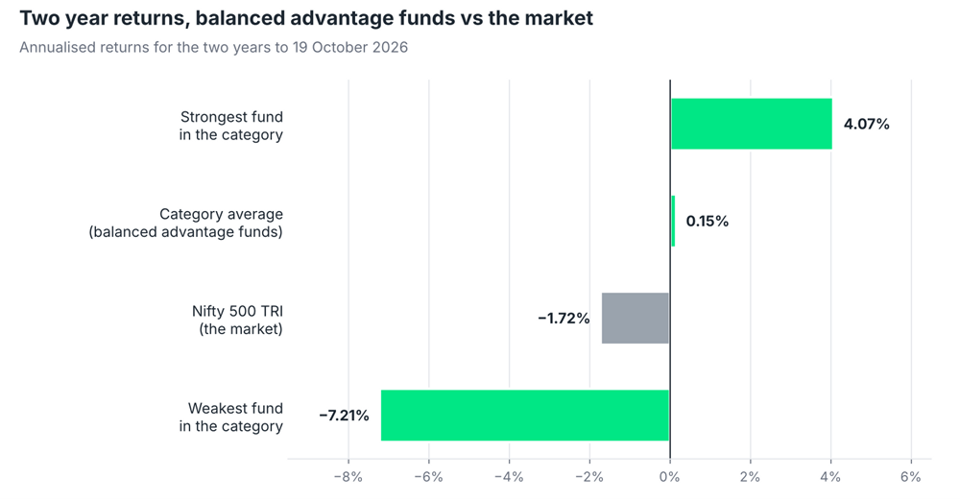
Source: ACE MF data via The Economic Times, two-year annualised returns to 19 October 2026. Past performance may or may not be sustained in future.
Here is the surprise. One of the funds holding more than 80% in net equity was among the weakest performers. The steadiest fund in the group was among the strongest. So the equity number alone did not decide the result.
What sits inside the equity part matters too. Two funds with the same 65% net equity can behave very differently if one holds large, stable companies and the other leans on mid and small companies. The type of bonds in the debt part and the cost of hedging also affect returns.
Mohit Bagdi of MIRA Money suggested a simple test in the same report. Downside capture shows how much of a market fall a fund takes, and upside capture shows how much of a rise it catches. Catching 70% of the rise and 50% of the fall is a sensible trade. Catching 70% of the rise and 65% of the fall is not. Our alpha and beta explainer covers this idea.
Has this happened before, and what came next?
Yes. In past falls, balanced advantage funds have usually lost less than the market, and in strong rallies they have usually gained less. That trade-off is the whole point of the category. It cushions the falls and gives up some of the rise.
| Market phase | What the market did | What balanced advantage funds did |
|---|---|---|
| Covid fall, Jan to early Apr 2020 | Nifty fell almost 34% from its 20 January peak | Strongest funds lost 10% to 15% over three months |
| One bad day, 5 Aug 2024 | Nifty 500 fell 3.13% | Half of the funds fell 1.5% or less |
| Rally, Apr to Jun 2025 | Sensex rose 10.6% | The typical (median) fund rose 7.3% |
| Two years to 19 Oct 2026 | Nifty 500 TRI lost 1.72% a year | Category average gained 0.15% a year |
Source: Cafemutual (April 2020), Business Standard with AMFI data (August 2024), Value Research (2025), The Economic Times (October 2026). Past performance may or may not be sustained in future.
During the Covid fall, one of the largest funds in the category pushed its net equity close to 74%, as Business Standard reported. Buying into a crash helps when markets bounce back, but only if the bounce comes. If a fall drags on, a fund that buys early simply holds more equity while prices keep sliding.
Our look at whether to stop your SIP after flat years puts this period in a longer frame.
What does a balanced advantage fund do inside your portfolio?
Think of it as a self-adjusting middle layer. It changes its equity share with valuations and market conditions, and rebalances for you, with no selling on your side. Because this happens inside the fund, you do not pay capital gains tax each time it shifts. It also takes some emotion out of decisions.
Most of us know we should buy more when markets are cheap, but few of us do it because falls feel scary. A balanced advantage fund follows its model instead of the news, so it can add equity while headlines are gloomy and trim it while everyone is excited.
Rebalancing means bringing your equity and debt mix back to where you want it. Most of us plan to rebalance every year, in the same way we plan a morning walk every day. With separate equity and debt funds, each switch means selling units, which can trigger capital gains tax. When a hybrid fund rebalances inside its own portfolio, you pay nothing on those moves, as Business Standard has explained. You pay tax only when you sell your units. 🙂
For funds taxed as equity, gains within 12 months are taxed at 20%, and gains after that at 12.5% above ₹1.25 lakh a year, as per DSP Mutual Fund. A few funds keep less than 65% in equity and are taxed differently, so check each scheme's tax status with a tax professional.
Here is a simple illustration, not a projection, which assumes the debt part earns nothing. Say you put ₹10 lakh in a fund with 50% net equity. If the market falls 20%, you have ₹9 lakh, while a full equity investor has ₹8 lakh. Now the fund raises net equity to 65%, and the market climbs 25% back to where it started. You end near ₹10.46 lakh, while the full equity investor is back at ₹10 lakh.
But if the market had simply risen 20% from the start, you would gain ₹1 lakh against ₹2 lakh for full equity. Which outcome would you rather live with? 🤔
For a first-time investor or someone moving from fixed deposits, this kind of fund can be a gentler first step into equity. For a salaried investor in their 30s or 40s, it can be the steadier part of a portfolio next to pure equity funds. Near retirement, take more care. A 2024 PrimeInvestor study compared two ways of taking a regular income. Withdrawing from the debt fund in a separate equity and debt mix worked better than withdrawing from a single balanced advantage fund. That is because each withdrawal from the fund also sold equity during falls. Our guide to the SWP bucket strategy explains this in detail.
What should you check in your balanced advantage fund now?
Start with the fund's model, then check whether it did what it said. Look at net equity over time, downside and upside capture, and rolling three to five year returns. Then ask yourself when this fund will look bad, and whether you will stay invested then.
Experts quoted by The Economic Times agree that these funds should be judged over three to five years and a full market cycle. Rolling returns help, because they check many overlapping periods, so one lucky or unlucky start date does not decide the verdict.
- Read the model in the scheme document. Is it based on valuations, trends or both?
- Track net equity, not gross equity, in the monthly factsheet.
- Check whether the fund used its allowed range across market phases, or barely moved.
- Compare downside and upside capture, not just last year's return.
- See what sits inside the equity part and how good the debt part is.
- Give it at least three to five years, and judge it over a full cycle.
Our guide on how to analyse a mutual fund before investing walks through more of these checks.
One honest caveat. No model can call tops and bottoms every time, and a fund that bought early could still see more pain if prices slide further. A balanced advantage fund reduces the swings but does not remove them. The real question is not whether your fund bought the dip. It is whether you understood its model before the dip came.
If you want to see how a steadier mix fits your long-term goals, check your Financial Freedom Score in about two minutes.
Disclaimer: This article is for general information and education only and is not investment or tax advice. Vinca Wealth is an AMFI-registered Mutual Fund Distributor (ARN-293401). Mutual fund investments are subject to market risks, read all scheme related documents carefully. Past performance may or may not be sustained in future.
Frequently Asked Questions
Is a balanced advantage fund safe for beginners?
It usually swings less than a pure equity fund, but it can still lose value because it holds shares. For beginners, it can be a gentler first step into equity.
Can I start a SIP in a balanced advantage fund?
Yes, most funds in this category accept SIPs. A SIP spreads your buying over time, while the fund manages the equity and debt mix. It does not remove market risk.
Is a balanced advantage fund good for retirement income?
It can be one part of a retirement mix. Taking all withdrawals from it has limits, because withdrawals also sell equity during market falls.
How is a balanced advantage fund taxed in India?
If it keeps 65% or more in equity, it is taxed like an equity fund. Gains are taxed at 20% within 12 months, and at 12.5% above ₹1.25 lakh a year after that, under FY 2026-27 rules.
Is Vinca Wealth registered?
Yes. Vinca Wealth is an AMFI registered mutual fund distributor (ARN-293401), based in Bengaluru, Karnataka. Our company CIN is U65999KA2022PTC169569, and our Insurance POSP Code is 1726204591.
Do I have to pay Vinca Wealth any fee?
No. We don’t charge you a fee for planning or investing. As a mutual fund distributor, we receive a commission from the fund houses whose schemes you invest in, and we disclose this upfront. You invest directly from your bank account to the fund house; your money never passes through Vinca Wealth.
How can I find out if I’m on track for retirement?
Start with our free Financial Freedom Calculator on vincawealth.com. In about 2 minutes it estimates your retirement corpus, your gap and your projected retirement date. You can then book a one-on-one session with our team to build a goal-based plan.
Can I meet the Vinca Wealth team?
Yes. We meet clients one-on-one at our office in Bengaluru or at a place of your choice in Bengaluru. If you live in another city or outside India, we connect over a video call.