Why Silver Prices Are Rising and What Indian Investors Should Understand


Get data-backed market insights
Well-researched articles on markets, equities, mutual funds and investing, delivered to your inbox.
Introduction
Over the past year, silver has captured investors’ attention in India. It has delivered strong local returns and, in certain months, even outperformed gold. As of now, silver is trading near ₹1.5 lakh per kilogram, close to its all-time high.
This rally is not just about hype. Silver is unique because it plays a dual role, it is both an industrial metal and a precious metal. This dual nature gives it higher potential returns than gold, but also greater volatility.
Before clients jump into silver, it’s important to understand why prices have risen, how the market works in India, and what factors are truly driving this uptrend.
India’s Dependence on Silver Imports
India depends heavily on global supply for silver. Domestic mining is very small compared to what the country consumes. Reports show that more than 80 percent of India’s silver demand is met through imports (NDTV).
In 2022, India imported a record 9,450 tonnes of silver (Business Standard).
In 2024, imports were estimated around 7,000 tonnes as industrial demand grew strongly.
Since most of India’s silver is imported, the price we pay here depends on three major things: the global price of silver, the rupee’s exchange rate with the US dollar, and import duties. So, even if silver prices remain stable globally, Indian prices can still rise if the rupee weakens or import costs increase.
Fundamental Drivers Behind Silver’s Boom
1. Industrial Demand: The Growth Engine
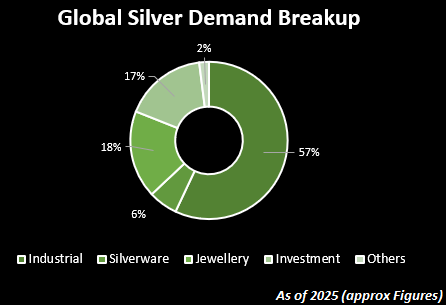
Silver is no longer just for ornaments or coins. More than half of the silver produced worldwide now goes into industrial use.
Here’s how it breaks down:
Solar energy (PV cells): about 20 percent of global demand.
Electric Vehicles (EVs): 10 to 12 percent.
Electronics and AI hardware: 15 percent.
Other industrial uses: 7 to 10 percent (including medical devices and water purification).
In India, this trend is even more visible. For example, in Gujarat, about 60 percent of silver imports were used for industrial purposes, mainly for solar and EV projects (The Times of India) It has become a critical component of India’s renewable energy and technology industries. The more the world pushes toward clean energy and electric vehicles, the more essential silver becomes.
2. Supply Deficit: When Demand Outpaces Supply
Globally, silver production has been unable to keep up with rising demand. The Silver Institute and Axis Mutual Fund have both pointed out that the market is facing multi-year supply deficits.
One reason is that most silver is mined as a by-product of other metals like copper, lead, or zinc. So even when prices rise, silver output cannot increase quickly unless the production of those metals also rises.
This imbalance between strong demand and limited supply has drained inventories in major hubs such as London and Zurich. It has also increased premiums and pushed global and Indian prices higher.
How Currency Movements Affect Silver/gold Prices in India
Since India imports most of its silver/gold, global prices are converted into rupees based on the USD-INR exchange rate. Let’s make this easy to understand with an example.
Suppose the international silver price is 30 US dollars per ounce.
When 1 dollar = ₹80, the base price becomes 30 × 80 = ₹2,400 per ounce, which is about ₹77,000 per kilogram (1 kg = 32.15 ounces).
Now, if the rupee weakens and 1 dollar = ₹90, the base price becomes 30 × 90 = ₹2,700 per ounce, or roughly ₹86,800 per kilogram.
So even though the global silver price stayed the same, Indian prices rose 12 to 13 percent simply because the rupee lost value.
This is why silver prices in India often rise even when global prices are stable – the rupee’s weakness adds another layer of price pressure, and it applies same with the gold.
The Gold-to-Silver Ratio
The gold-to-silver ratio (GSR) measures how many ounces of silver are needed to buy one ounce of gold. The formula is:
GSR = Price of Gold ÷ Price of Silver
Historically, this ratio has averaged around 60:1, meaning gold has typically been about sixty times more expensive than silver.
Today, the ratio is around 100:1, which means gold is one hundred times more expensive per ounce. This tells us that silver is relatively cheaper compared to gold right now.
For investors, a high GSR usually indicates that silver could have more upside potential if it starts catching up with gold. However, silver is what we call a high-beta metal – it moves faster and more sharply than gold. It can outperform during rallies but can also correct more quickly.
So, while the current ratio suggests room for silver to rise, clients should remember that it carries higher volatility and risk.
Conclusion and Takeaway
While silver has recently outperformed many assets, this trend may not last forever. Prices in commodities often move in cycles, so decisions should not be based only on short-term highs. Investors should align their portfolios with personal financial goals and risk capacity. A small allocation to silver and gold can add diversification, but core investments should remain goal focused.
At Vinca Wealth, we offer professional financial planning to help you achieve true financial freedom. If you’re unsure how to structure your portfolio, book a free consultation with us and let’s build it together.
Frequently Asked Questions
Is Vinca Wealth registered?
Yes. Vinca Wealth is an AMFI registered mutual fund distributor (ARN-293401), based in Bengaluru, Karnataka. Our company CIN is U65999KA2022PTC169569, and our Insurance POSP Code is 1726204591.
Do I have to pay Vinca Wealth any fee?
No. We don’t charge you a fee for planning or investing. As a mutual fund distributor, we receive a commission from the fund houses whose schemes you invest in, and we disclose this upfront. You invest directly from your bank account to the fund house; your money never passes through Vinca Wealth.
How can I find out if I’m on track for retirement?
Start with our free Financial Freedom Calculator on vincawealth.com. In about 2 minutes it estimates your retirement corpus, your gap and your projected retirement date. You can then book a one-on-one session with our team to build a goal-based plan.
Can I meet the Vinca Wealth team?
Yes. We meet clients one-on-one at our office in Bengaluru or at a place of your choice in Bengaluru. If you live in another city or outside India, we connect over a video call.