Gold and Silver Crash 2026, Is It the Right Time to Buy Gold?
What past crashes, the silver deficit and today's interest rates really say before you buy the dip


Get data-backed market insights
Well-researched articles on markets, equities, mutual funds and investing, delivered to your inbox.
In January 2026, gold and silver were the stars of every family WhatsApp group. By late November, gold had lost about a third of its value and silver nearly two thirds. Now the same groups ask a new question, is it the right time to buy gold and silver while they are cheaper? This article answers that question with data and history, not predictions.
That question hides smaller ones. Why did prices fall so hard, and does silver's supply deficit protect it? How long did past crashes take to heal, and what could turn prices around? We answer each one using World Gold Council, Silver Institute, US Federal Reserve and World Bank figures, plus some numbers of our own. 🤔
Is it the right time to buy gold now that it has become cheaper?
A lower gold price alone does not make this the right time to buy gold. GoldPrice.com data shows gold closed at a record $5,405 an ounce on 29 January 2026 and was 34% lower on 24 November 2026. The higher US interest rates that drove the fall were still in place.
A share earns profits and a bond pays interest, so you can judge their price against what they earn. Gold earns nothing, so its price is simply what the next buyer will pay. Cheap only means cheaper than before, not necessarily good value.
In rupees, the fall looks a little smaller. On MCX, India's commodity exchange, gold futures touched a record ₹1,80,501 per 10 grams on 29 January 2026, the Free Press Journal reported. By 26 November they traded near ₹1,23,370, IIFL reported, about 32% lower. The rupee weakened from about ₹91 to ₹95.5 per dollar between January and October 2026, US Federal Reserve data shows, and that softened the blow for Indian holders. 🙂
So the useful question is not whether gold is cheap. It is whether your reason for owning gold still holds, and whether the forces behind the fall are fading.
Why did gold and silver prices fall so much after January 2026?
Gold and silver fell mainly because US interest rates went up instead of down in 2026. The US Federal Reserve raised rates on 16 September 2026, its first hike since 2023. Federal Reserve data shows the 10-year real bond yield at 2.79% on 23 November 2026, among its highest levels since 2003.
The first crack came on 30 January 2026, when Kevin Warsh, seen as a tough inflation fighter, was named the next Fed chair. Silver crashed as much as 37% that day, its biggest one-day fall on record, Business Today reported. The US exchange CME then raised margins, the cash deposit traders must keep against their bets, CNBC reported. Traders who had borrowed heavily could not pay, so their positions were sold automatically. 😢
The second blow was the war with Iran from 28 February 2026, and here most headlines missed the real chain. People expect gold to rise in a war, but this war hurt it. Oil jumped about 50% within weeks, Trading Economics reported, which pushed inflation up. Rising inflation led the Fed to raise rates in September, and Forbes reported in November that markets expect another hike in December.
Why do higher rates hurt gold? A real yield is the interest a safe bond pays after removing expected inflation. Gold is like a cricket bat kept in a locker, useful one day but paying nothing while you wait. When the 10-year US real yield rose from 1.82% to 2.79% in a year, waiting with the bat became costlier. Macrotrends, using Federal Reserve data, shows this level is higher than on 99% of trading days since 2003.
A stronger dollar added pressure, because gold is priced in dollars worldwide, and the dollar index hit a 20-month high in November, FXStreet reported. Even central banks did not support gold every month. The World Gold Council reported that they were net sellers of 30 tonnes in March 2026, led by Turkey, before buying 321 tonnes between July and September.
Why did silver fall twice as hard as gold, even with a supply deficit?
Silver fell about twice as hard as gold because no central bank buys silver as a reserve and its market is far smaller. FXStreet reported silver 65% below its January 2026 peak on 24 November 2026. The Silver Institute also expects silver demand to fall 5% in 2026 as high prices hurt buyers.
Gold has a buyer of last resort, someone who keeps buying when others sell. Central banks bought 863 tonnes in 2025 and 675 tonnes in the first nine months of 2026, the World Gold Council says, but no central bank stores silver. Silver's market is also small. By World Gold Council and Silver Institute figures, a year of silver demand was worth about $45 billion in 2025, against roughly $550 billion for gold. So the same selling moves silver far more.
A deficit simply means the world used more silver in a year than mines and recycling supplied. The Silver Institute's November 2026 update expects a 35 million ounce deficit this year, the sixth in a row. That sounds like good news for prices, but the deficit was 124 million ounces in 2024 and 54 million in 2025, so it is closing fast.
High prices are closing it, because people buy less and sell old silver. For 2026, the Silver Institute expects jewellery demand to fall 22% and silverware 17%, while recycling rises 6% to its highest since 2012. Solar panel makers also use less silver per panel.
A deficit is also a yearly gap, not an empty cupboard. Silver exchange funds alone held about 1.25 billion ounces in early November 2026, the Silver Institute says, so this year's gap is under 3% of that. Think of a water tank that loses a few buckets a year while still holding thousands.
Supply has one real quirk. Only about 28% of mined silver comes from silver mines, by Silver Institute figures, and the rest is a by-product of lead, zinc, copper and gold mining. So supply cannot jump when prices rise. That helps prices over years, but MCX silver futures fell about 65% from their record ₹4,20,048 per kg on 29 January 2026, based on Motilal Oswal and IIFL prices.
How long did gold and silver take to recover after past crashes?
Gold's recovery after big crashes has taken from 3 years to 26 years in US dollars. Our calculation from World Bank monthly prices since 1973 covers gold's three deepest falls. Gold needed 3.2 to 26.3 years to regain its peak in dollars, but only 3.2 to 6.8 years in Indian rupees.
We worked this out ourselves, because the rupee side of this story rarely gets told. We converted the World Bank's monthly average gold price into rupees using the Federal Reserve's monthly exchange rate, then measured how long each fall took to regain its old peak. Rupee figures are before import duty and GST.
| Gold peak | Fall in $ | Years to new high in $ | Fall in ₹ | Years to new high in ₹ |
|---|---|---|---|---|
| 1974 | 40% | 3.2 | 34% | 3.2 |
| 1980 | 62% | 26.3 | 45% | 6.7 |
| 2011 ($) and 2012 (₹) | 39% | 8.8 | 25% | 6.8 |
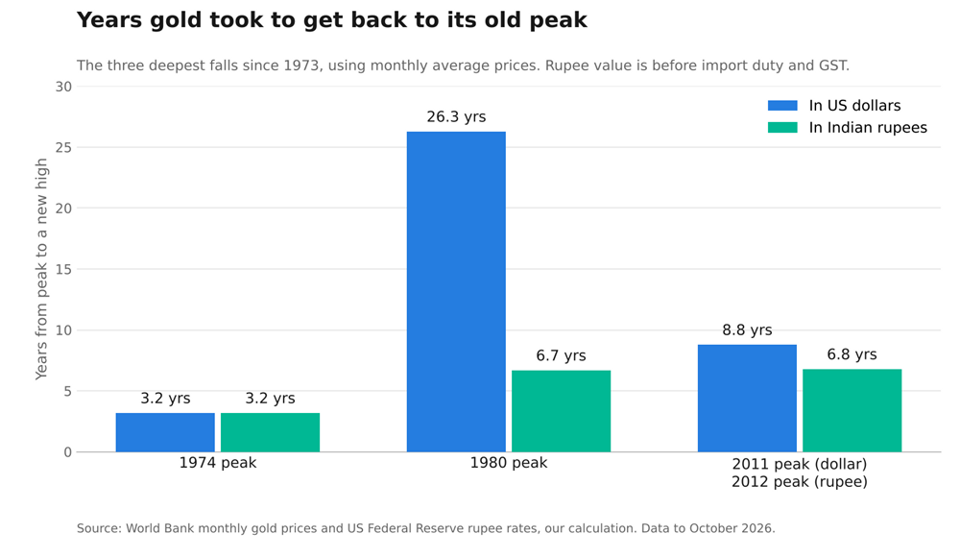
The rupee is the quiet hero here. After the 1980 peak, gold took 26 years to recover in dollars but under 7 in rupees, because the rupee kept weakening against the dollar. That cushion is not certain, since a stronger rupee would work the other way.
Silver's history is harsher. Its January 1980 peak of $49.45 was beaten only in October 2025, about 45 years later, Marketplace reported. Its April 2011 peak of $48.70 sank to about $13.65 by late 2015, BullionVault noted, a 72% fall that took about 14 and a half years to recover.
Did steady buying help during the long wait? Take a made-up investor who put ₹10,000 a month into gold from the rupee peak of September 2012 until July 2019, when the price was back at that peak. In this illustration, using monthly average prices before costs, duty and tax, ₹8.3 lakh grew to about ₹9.8 lakh, roughly 4.9% a year. A lump sum at the 2012 peak gained only about 2% in total. Past performance may or may not be sustained in future. Equity SIPs showed a similar pattern in our study of three past market slumps.
What could push gold and silver prices up again, and what could keep them down?
Gold and silver prices are likely to follow US interest rates, the US dollar and oil prices in the coming months. The World Gold Council described the outlook as evenly balanced in November 2026. Rising rates are the main risk, while central bank buying and record gold exchange-traded fund holdings give support.
Long-term buyers have not left. Central banks bought 321 tonnes between July and September 2026, up 42% from a year earlier, the World Gold Council reported. Global gold exchange-traded funds (ETFs) also held a record 4,256 tonnes. Indians kept buying too, with AMFI data showing ₹3,474 crore into gold ETFs and ₹3,092 crore into silver ETFs in October 2026.
On the other side, US core inflation hit 3.3% in October, its highest in nearly three years, FXStreet reported. If the Fed keeps raising rates into 2027, real yields could stay high and keep gold under pressure. Silver also faces weaker demand from jewellery, silverware and solar, which is a real problem.
What could change the picture? A clear end to Fed rate hikes, a lasting fall in oil, or a market shock would help gold, while silver would also need factory demand to pick up. Nobody knows which comes first, or when. Anyone who claims to know the exact bottom is guessing, a bit like predicting the exact over when rain will stop a match.
How do you decide the right time to buy gold or silver for yourself?
The right time to buy gold or silver depends on your own portfolio, not on the headline price. Decide what share of your money metals should hold, check where you stand, and fill any gap in small amounts over 6 to 12 months. Avoid borrowed money, and keep cash needed within three years away from silver.
Here is a simple checklist, though your age, goals and existing investments can change the answer.
- You already hold gold within your planned share. No action is needed, because gold is there to balance your other investments, so some years it will fall.
- Gold has slipped below your planned share. Topping up monthly is rebalancing, which means bringing your mix back to plan, not chasing a bottom.
- You hold no gold yet. A gold ETF or gold fund lets you start small and buy over months, without the risks of digital gold apps that SEBI warned about.
- You bought silver near the peak. Ask if you would buy it today for its role, because buying more to lower your average cost with money you need soon adds risk.
- You are close to retirement. Gold and silver pay no income, so money for the next few years of expenses fits better in steadier options.
- You are buying wedding jewellery. That is spending, not investing, so buy when needed and compare making charges, which can outweigh weeks of price moves.
How big should your planned share be? It should come from your goals, and our guide on how much of your portfolio should be in commodities explains the usual ranges and why too much can slow growth.
Know the tax rules too. As of FY 2026-27, gains on gold and silver ETFs held over 12 months are taxed at 12.5%, TaxGuru explains, while funds of funds need over 24 months. Shorter holdings are taxed at your slab rate, so check with a tax professional.
Buying slowly has a limit, because it will not protect you if prices keep falling for years, as after 1980 and 2011. Gold works best as a small shock absorber in a portfolio built for growth, not as the engine of that growth.
Frequently Asked Questions
What is the difference between a gold ETF and a gold fund?
A gold ETF trades on the stock exchange like a share and needs a demat account. A gold fund invests in gold ETFs for you, needs no demat account and allows a SIP.
Should I stop my gold SIP after this fall?
Not because of the fall alone. A SIP buys more units when prices are low. Stopping makes sense only if your reason for holding gold, or your planned share, has changed.
Is gold a good source of income in retirement?
No. Gold pays no interest or dividend, and its price can stay flat for years. Retirees usually hold a small amount as a shock absorber, not to pay monthly bills.
What does the gold to silver ratio say right now?
The ratio shows how many ounces of silver one ounce of gold buys. The Silver Institute says it fell to 43 in January 2026 and returned to the high 70s by early November.
Is Vinca Wealth registered?
Yes. Vinca Wealth is an AMFI registered mutual fund distributor (ARN-293401), based in Bengaluru, Karnataka. Our company CIN is U65999KA2022PTC169569, and our Insurance POSP Code is 1726204591.
Do I have to pay Vinca Wealth any fee?
No. We don’t charge you a fee for planning or investing. As a mutual fund distributor, we receive a commission from the fund houses whose schemes you invest in, and we disclose this upfront. You invest directly from your bank account to the fund house; your money never passes through Vinca Wealth.
How can I find out if I’m on track for retirement?
Start with our free Financial Freedom Calculator on vincawealth.com. In about 2 minutes it estimates your retirement corpus, your gap and your projected retirement date. You can then book a one-on-one session with our team to build a goal-based plan.
Can I meet the Vinca Wealth team?
Yes. We meet clients one-on-one at our office in Bengaluru or at a place of your choice in Bengaluru. If you live in another city or outside India, we connect over a video call.
About the Author